
At 19:40 Beijing time on October 14, 2026, LandSpace’s ZhuQue-2E Y4 lifted off from the Dongfeng commercial spaceport with ten satellites. Two of the payloads matter for anyone who builds, buys, or bets on AI infrastructure abroad: AdaSpace / Guoxing Hangyu’s “Star Computing” (星算) Group 02 — eight compute satellites that entered orbit and completed their first networking — and the first two craft of Guangzhou Haizhu’s Pazhou Space Intelligent Computing Constellation (琶洲太空智算星组), built by Yusuan Xinghe (宇算星河).
Chinese coverage puts the Star Computing constellation’s in-orbit compute after this networking step at about ~50P — 50 PFLOPS-class aggregate. That is not a consumer cloud region in the sky. It is a public demo that orbital AI compute has moved from slideware into hardware that talks to itself.
What actually launched
- AdaSpace Star Computing Group 02: eight compute satellites; first networking completed. Roadmap cited in Chinese reports: 2,800 compute sats (2,400 inference / 400 training), a commercial kilostar-scale network around 2030, and a fuller mesh by 2035.
- On-orbit tests claimed so far: foundation-model training in space, laser inter-satellite and ground links, ~10 kW-class liquid cooling, and large deployable radiative cooling wings — the thermal story terrestrial GPU halls also fight, just without an atmosphere to dump heat into.
- Pazhou / Yusuan Xinghe: first two compute sats of a planned 24-satellite constellation. Goal language includes 7×24 on-orbit ops, high-bandwidth laser links between sats and ground, cross-sat distributed “space LLMs” / space-based world models, and a MaaS/SaaS path aimed at traffic, emergency response, and agriculture. Haizhu aims for 24+ commercial sats in roughly three years.
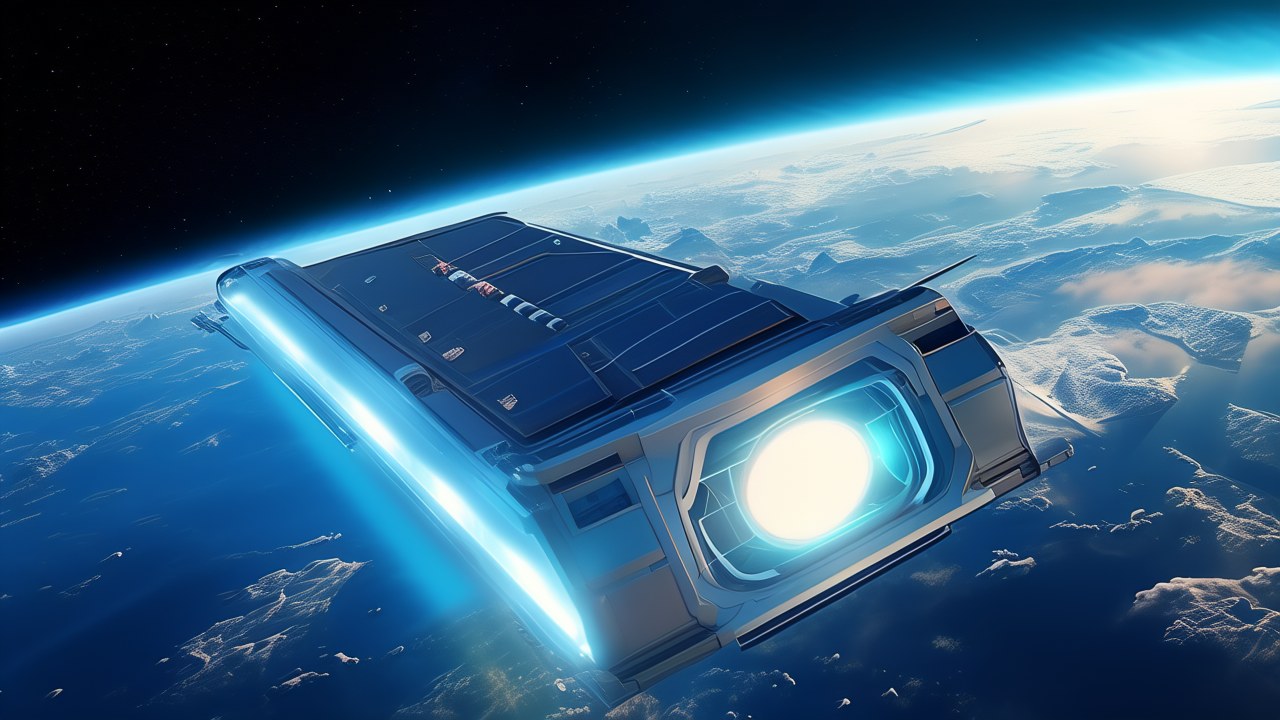
Illustration: a compute node in LEO — laser terminal forward, thermal hardware fighting the same heat problem as terrestrial AI racks.
Why a foreign reader should care
If you work on Earth observation, autonomy, or AI capacity planning, the interesting claim is not “China has rockets.” It is that inference (and early training experiments) move next to the sensors.
- EO before downlink: Today most space AI still means: capture pixels → dump raw or lightly compressed data → process on the ground. On-orbit compute flips the pipeline: classify, compress, or answer a query in space, then send only what matters. That cuts latency and spectrum load for disaster response, shipping, and agriculture use cases Pazhou is pitching.
- Laser mesh as the WAN: Inter-sat optical links are how you turn many small nodes into something that behaves like a distributed computer instead of a flock of lonely edge boxes. If that mesh works at commercial duty cycles, constellation compute stops being a novelty payload and starts looking like infrastructure.
- Competition with terrestrial power and cooling: Data-center builders abroad are already constrained by megawatts, water, and grid queues. Space does not magically erase physics — radiative cooling and ~10 kW-class liquid loops are hard — but it is a parallel R&D track aimed at the same bottleneck: where do you put the next PFLOPS when land and power are scarce?
- Two programs, one launch: A national-scale “Star Computing” roadmap beside a city-backed Pazhou constellation signals that Chinese commercial space + local industrial policy are willing to fund orbital AI as a product category, not only as a defense or science demo.
You cannot sign up for a public Star Computing or Pazhou API, rent a GPU-minute in orbit, or point your app at a space LLM endpoint. This is still a demo / infrastructure build-out phase. What you can do is treat the Oct 14 flight as a milestone: first networking at ~50P-class, dual payloads (AdaSpace + Pazhou), and published roadmaps (2,800 sats / 24-sat city constellation). Watch for laser link duty-cycle numbers, published training or inference benchmarks from orbit, and any commercial MaaS pilot — those are the tells that this graduates from press event to procurement.
What to watch next
- Measured networking, not just “entered orbit”: sustained laser throughput, handoff rates, and how much useful inference runs between ground contacts.
- Thermal honesty: whether ~10 kW-class liquid cooling plus radiative wings holds under continuous inference loads, or only under short test windows.
- Pazhou’s commercial path: first traffic / emergency / agriculture pilots, and whether overseas partners get data products (processed insights) rather than raw compute access.
- Export and access rules: orbital AI capacity may stay behind Chinese commercial and government customers for years; foreign firms should plan for downstream products (maps, alerts, models trained on space-processed EO) more than for renting the constellation itself.
For overseas engineers and investors, the sober reading is this: China is treating space as another place to put AI silicon, linked by lasers, aimed first at Earth observation and industrial SaaS. October 14 did not open a shop window. It did put a networked ~50P-class constellation on the scoreboard — and that is enough to keep on the same watchlist as terrestrial AI power constraints.