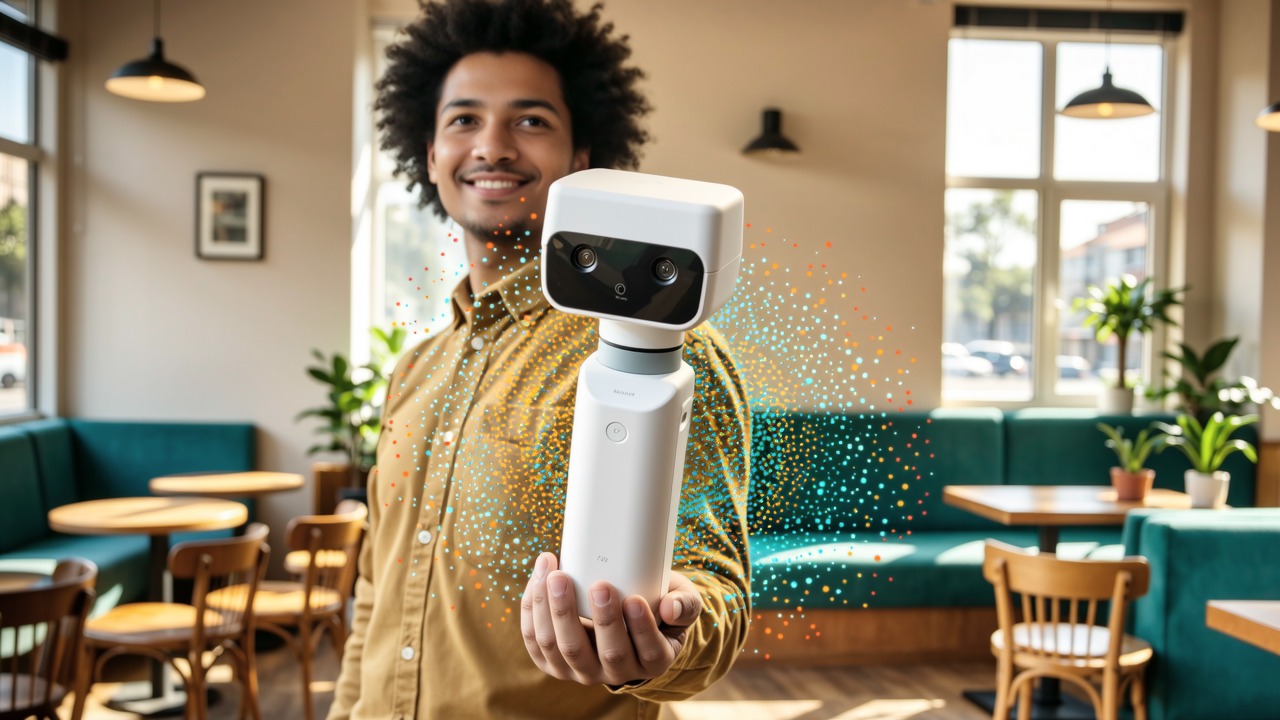
Physical AI keeps stalling on the same boring bottleneck: you can scrape the web for images and video, but robots need depth, pose, friction-ish geometry, and rooms that match the store they will work in. Pure sim looks clean and lies. Teleop trajectories are real and ruinously expensive. Hesai Technology (禾赛科技, NASDAQ: HSAI) says its answer is a productized 3D world data engine called Kosmo, launched October 14, 2026 with hardware Kosmo One and cloud Kosmo World.
If you work on robot policy training, world models, or LED-stage VFX, the interesting part is not another lidar press kit. It is a capture loop that claims to spit out sim-ready, spatially aligned assets — and a public path into Pixar RenderMan that already has a tutorial from a Pixar-adjacent artist.
What Kosmo One actually captures
Hesai pitches Kosmo One as the first 8K AI spatial camera that packs high-resolution lidar, an 8K imaging path, a 1-inch CMOS, and a high-precision IMU into one device, with microsecond-level sync across geometry, color, texture, and pose. Reconstruction uses 3D Gaussian Splatting (3DGS). The company claims millimeter-level geometric precision. One footnote matters for anyone buying the brochure: 8K is the camera’s capture claim; exported files top out at 6K.
On usability, Hesai says ordinary indoor space of about 100 m² can be scanned in roughly 15 minutes, and that Kosmo World generates models about 5× faster than similar 3DGS products under comparable conditions. Those are company benchmarks with the usual “depends on scene and settings” caveats — treat them as claims until you time a scan yourself.
One rebuild, three aligned representations
Under the hood sits Kosmo Spatial Core (KSC). Hesai’s useful engineering claim is that a single rebuild produces 3DGS + mesh + depth, already spatially aligned, plus AI semantic segmentation so objects become labeled, sim-ready pieces instead of a pretty blob. In robot terms: appearance (3DGS), interactable geometry (mesh), and metrically useful range (depth) are supposed to describe the same world the policy will see, grasp, and measure.
For world-model teams, Kosmo also claims 1:1 real 3D with poses and depth, plus automatic generation of 10,000+ training trajectories from one space — pitched as 100×+ efficiency versus the cost of a single high-quality real teleop trajectory. Again: company framing, not an independent audit.

Illustration: the other buyer — a film/VFX desk treating a scanned plaza as editable 3DGS assets inside a production render pipeline.
The DQ ice-cream store case (company numbers)
Hesai’s flagship deployment story is a Sharpa robot in a Dairy Queen ice-cream store. Manual store modeling, they say, took a professional team about 300 hours; Kosmo scanned and rebuilt a high-fidelity training environment in about 15 minutes. Failures reportedly fell to one-tenth, task success rose to 99%, and the robot went live in the real shop. That is a compelling before/after if true — and it is still a vendor case study, not a peer-reviewed field trial. Ask for the failure definition and the teleop baseline if you are writing a procurement memo.
RenderMan, Amap, and the partner list
The overseas-facing proof point is creative tooling. Hesai says Kosmo’s 3DGS feeds into Pixar’s RenderMan pipeline; Pixar published an official tutorial, and artist Dylan Sisson wrote up scanning a Pixar plaza and rendering it in RenderMan on his blog. That is a concrete artifact you can open today, separate from Hesai’s own marketing pages.
Other named partners and integrations from the launch: Amap/Gaode “flight street view” for museums and galleries; robot firms Galaxy General Robot (银河通用) and Force Lingji (原力灵机); UN partner TRIC with a Du Fu Thatched Cottage digital-art project; plus hooks into NVIDIA Isaac Sim / Isaac Lab, Unreal Engine, and Houdini. Hesai also continues its motion-engine pitch — Sharpa’s dexterous hand in NVIDIA’s Isaac GR00T reference stack, and the Wave W01 tactile hand — while reminding investors it claims #1 lidar share in ADAS passenger cars and Robotaxi, with a Palo Alto office at 3500 W Bayshore Rd.
Kosmo is commercial hardware plus cloud from a public company (NASDAQ: HSAI) — not open weights, not a free dataset dump, not a Hugging Face checkpoint. If you are a robotics or world-model lab, the realistic next steps are: talk to Hesai sales / the Palo Alto office, check whether Isaac Sim or UE export matches your stack, and time a pilot scan against your current photogrammetry or Matterport-ish workflow. If you are a VFX/CG artist, start with Dylan Sisson’s public RenderMan write-up and Pixar’s Kosmo tutorial before budgeting a scanner. Independent verification of the 15-minute / 5× / 100× numbers is still on you.
The bet underneath the product
Hesai’s CTO framing is blunt: physical AI is not short of “data,” it is short of real-world data with depth and pose; pure sim cannot fake materials and contact; teleop does not scale. Kosmo is the company’s attempt to productize that missing middle — and to grow a second engine beside automotive lidar. For overseas builders, the test is practical: does one afternoon with Kosmo One beat your current store-digitization pipeline on cost and policy transfer, and can the assets land cleanly in Isaac, UE, or RenderMan without a week of cleanup? The RenderMan path is the rare piece you can inspect without a sales call. The robot metrics still need a skeptical stopwatch.