If you buy MRO or production parts into a Thai line, a Hungarian plant, or a Gulf site, the usual China story is still “order from Shenzhen, wait on the boat.” On October 14, 2026, at the China International Industry Fair in Shanghai, JINGDONG Industrials (京东工业, JDi) — JD.com’s industrial supply-chain business — and industry partners launched the JDi Global Supply Chain Connectivity Alliance. The stated goal is blunt: connect manufacturers, customers, and service partners with digital technology and international fulfillment networks so sourcing and delivery improve across markets, not just inside China.
That framing matters more than the ribbon-cutting. JDi is not pitching a new consumer app; it is pitching industrial SKUs that can sit closer to the factory that needs them, with systems that talk to each other. Coverage of the launch (relayed via Chinese industry press) puts JDi’s overseas footprint in Thailand, Indonesia, Malaysia, Vietnam, Hungary, Brazil, Saudi Arabia, and the UAE, serving roughly 100 enterprises across automotive manufacturing, electronics, and new energy — local and multinational buyers as well as Chinese companies expanding abroad.
Thailand as the concrete SLA
Local fulfillment is the part overseas buyers can price. In Thailand, JDi says it mixes local sourcing, cross-border procurement, and locally stocked inventory so plants can trade speed against cost. Orders fulfilled from stock held in Thailand are claimed to deliver in two to three days; cross-border orders typically take 25–35 days. Those are company figures from the launch reporting — useful as a planning band if you are comparing a Bangkok-buffer SKU against a full China pull, not as a contractual SLA you can cite without a commercial conversation.
For a Chinese factory opening a SEA line, that is the difference between air-freight drama and a buffer that behaves like a regional distributor. For a Thai or Vietnamese buyer who already sources Chinese industrial parts, it is a path to keep some SKUs onshore without building your own bonded warehouse.

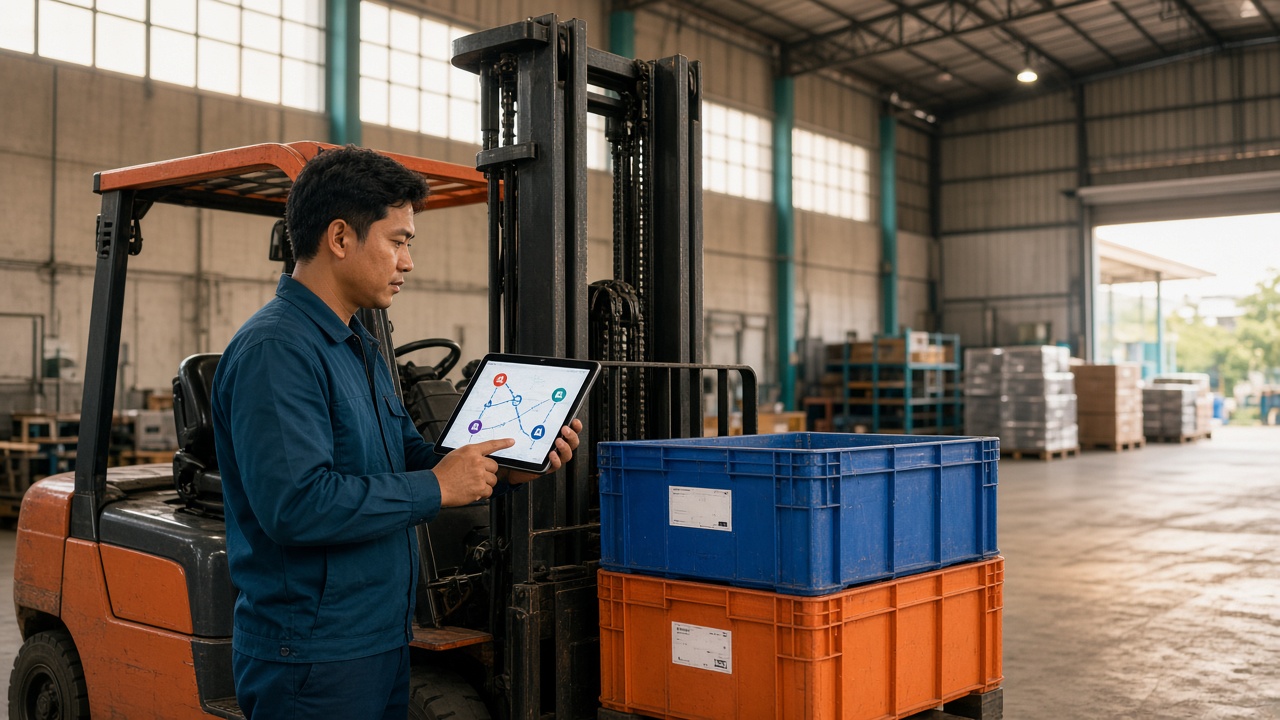
Illustration: the other side of the alliance — a plant procurement desk trying to close local-sourcing gaps without giving up China cost curves.
Minth’s Europe note: systems, not slogans
At the accompanying international business forum, partners talked about reliability through technology and tighter collaboration. Chen Mo, spare-parts procurement manager at Minth Group (敏实集团), framed the problem as connecting fragmented local demand with dependable global supply. He said Minth has already worked with JINGDONG Industrials in Europe to address gaps in local sourcing and fulfillment, connect procurement systems, and cut costs in selected product categories.
That is a useful overseas signal even if you never buy from Minth: the alliance story is being sold as system connect + local gap fill, not as a pure cross-border marketplace. If you run European or Middle East industrial procurement for a China-born OEM, the question to ask JDi (or your existing JD industrial account manager) is which categories already have local stock and which APIs or EDI hooks exist for your ERP — not whether another alliance logo appeared at CIIF.
AI agents for customs and warehousing
JDi also says it is advancing AI agents for customs clearance and warehousing, aimed at chopping routine administrative work across markets with different paperwork. Alongside large-enterprise support, the company says it is extending services to SMEs in international markets. Those agents are described as under development/application — treat them as a roadmap claim until you see a product page, a pilot invite, or a customs broker you can call. The strategic intent is clear enough: industrial cross-border deadlocks are often paperwork and put-away, not only ocean transit.
This is a B2B industrial supply-chain alliance and fulfillment footprint announcement from JD’s industrial arm — not a consumer storefront you browse tonight, and not an open API dump. If you are a global industrial buyer or a Chinese plant expanding into SEA / Europe / the Gulf: ask JDi which of the named countries already hold stock for your HS codes, what the Thailand 2–3 day path requires (MOQ, SKU eligibility), and whether Minth-style system connect is available for your ERP. If you are an SME abroad that has been stuck on China-only MRO catalogs, ask whether the SME extension covers your market and onboarding path. Independent verification of the ~100-enterprise count and the day-count SLAs is still on you — start with your category manager, not the press release alone.
How to read the alliance
Chinese industrial platforms going abroad usually fail one of two ways: they ship like a domestic B2B site with a longer UPS label, or they open a warehouse that never matches the SKUs plants actually reorder. JDi’s CIIF launch is trying to answer both — local stock where it already has a footprint, partner collaboration for the long tail, and AI agents for the customs grind — while planting a flag with about a hundred named-sector customers.
The honest overseas takeaway is narrower. Thailand’s 2–3 vs 25–35 day split is the measurable claim. Europe work with Minth is the systems claim. The eight-country list is the coverage claim. Until you get a commercial quote for your parts list, the alliance is a signal that JD’s industrial stack wants to be a regional fulfillment partner for industrial buyers and outbound Chinese factories — worth a sales call if those day-counts would change your safety stock, not a purchase order by itself.