
If you already ship agents with llama.cpp or vLLM, the usable headline is narrow and concrete: Houmo is putting adapters for those familiar runtimes on GitHub, plus a wider four-layer toolchain that is supposed to cover everything from model quant/compile through fleet deploy. The silicon underneath is the company’s mass-produced M50 SRAM CIM part — company figures put it around 160 TOPS INT8 at a typical ~10 W, with a claimed native float path that is meant to cut the usual “crush to INT8 then claw accuracy back” dance.
The announcement landed at Houmo’s partner ecosystem conference around October 14, 2026, and was reported in Chinese tech coverage (including a DeepSignal deep-dive based on 新智元, plus TheRoboRadar on Oct 15). This piece sticks to those attributed numbers — no invented prices or third-party benchmarks.
What is opening, in four layers
Houmo frames the stack as four layers, to be opened in three batches with roughly 15 open-source projects planned by January 2027:
- Model processing — quantization, compile, accuracy evaluation (repos such as
postmo-quantflow/ ModelZoo already appear under the org). - Inference frameworks, ops, and runtime — the silicon-shaped layer; first-batch llama.cpp and vLLM adapters (
vllm-postmoand kin). - Domain kits / middleware / multi-model pipelines — glue for speech→summary→app style chains and multi-model agent/robot flows.
- Deploy and ops — Kubernetes / NPU cluster tooling for upgrade, monitor, and fleet delivery after a prototype leaves the desk.
The first batch is the pragmatic one: keep the developer workflow you already know, swap in a Houmo-backed backend when you have M50 hardware. Later batches are where Houmo’s own frameworks and productization middleware are supposed to land. Treat the Jan 2027 count as a roadmap, not a guarantee — the live check is commit activity on github.com/houmo-ai and the docs at developer.houmoai.com.
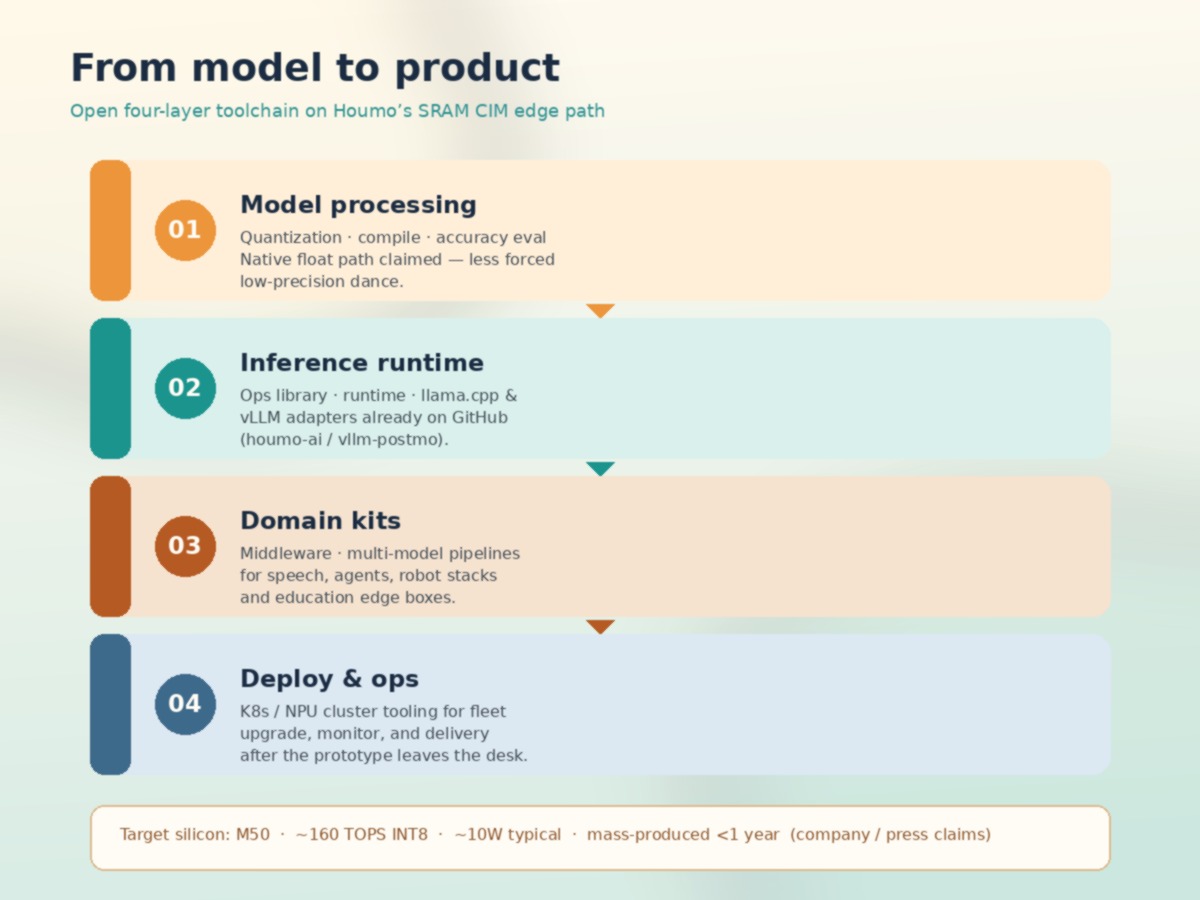
Illustration: model → runtime → domain kits → deploy/ops — amber/teal workshop palette, not a reused dark infographic.
The M50 pitch — and the product examples
Vendor and press materials describe the M50 as SRAM compute-in-memory versus a classic von Neumann split of “memory warehouse / compute workshop.” The company claims roughly a 70% area cut and about 1/10 the power of comparable traditional designs — label those as claims until independent silicon reviews land. Mass production is said to be under a year old; Houmo also claims 150+ terminal products committed and 100+ customers.
Example products named in coverage:
- Lenovo AI host P7 — about 300 g, whole system around 30 W, local run of a ~122B-parameter model, 128K context, ~50 tok/s claimed (company/press demo figures).
- Great Wall N90 Pro — offline-oriented domestic laptop path.
- Companion / embodied robots and education edge boxes (campus training units and similar).
Houmo’s marketing frame for boxes like the P7 is an “edge token factory”: buy the hardware once for always-on local agents instead of metering cloud tokens 24/7. That is a business-model story, not a measured TCO study — useful as framing if you are comparing prepaid edge inference to API bills, weak as proof that any specific box beats your cloud SKU.
Public GitHub under houmo-ai already shows pieces such as postmo-modelzoo, postmo-quantflow, and vllm-postmo — enough for an overseas engineer to read adapters, docs, and ModelZoo layout. Running them for real still wants M50 hardware (or a vendor-supported host path from the quickstart). The “150+ products” figure is a design-win / commitment count in press coverage, not audited units shipping. Float-on-CIM maturity and long-tail op coverage are the usual CIM risks; community maintenance of the open repos will decide whether this is a durable path or a one-conference dump. Expect China-oriented OEM channels for boards and boxes unless Houmo or partners publish an international buy page.
Roadmap: MoE wants capacity, Dense wants bandwidth
Houmo splits future silicon on model shape. 2D CIM (M30/M50 → M60/M66) is aimed at MoE and generative workloads that need big resident capacity with external GDDR/LPDDR. 3D CIM (A20 already taped out, per company materials) targets dense models that starve for bandwidth. The architectural claim is that stacking near-memory feed on top of in-memory compute compresses the data-movement tax from both distance and pipeline. Again: roadmap language from the company, not a retail SKU list.
Why a chip company opens the stack
CEO Wu Qiang’s résumé is part of the pitch: OpenCL founding-team background, AMD GPGPU work, Meta energy/cluster optimization, later Horizon CTO before founding Houmo. The open-stack philosophy is framed as the OpenCL pattern applied to edge silicon — lower integration friction so M50 becomes a default rather than a closed SDK island. Commercially, that only works if the repos stay maintained and the adapters actually track upstream llama.cpp / vLLM; openness without commits is just a press PDF.
Business-model angle
Cloud agent spend is mostly tokens plus tool APIs. Houmo’s counter-offer is prepaid local tokens on a ~10 W class CIM part, with the software tax opened so OEMs and ISVs do not each rebuild quant→runtime→fleet glue. For overseas product teams, the near-term experiment is: can you get an M50 path, clone the first-batch adapters, and measure tokens-per-watt and accuracy on your models — not Lenovo’s demo slide. Until that hardware is on your desk, treat the GitHub org as documentation of intent and a preview of the programming model.