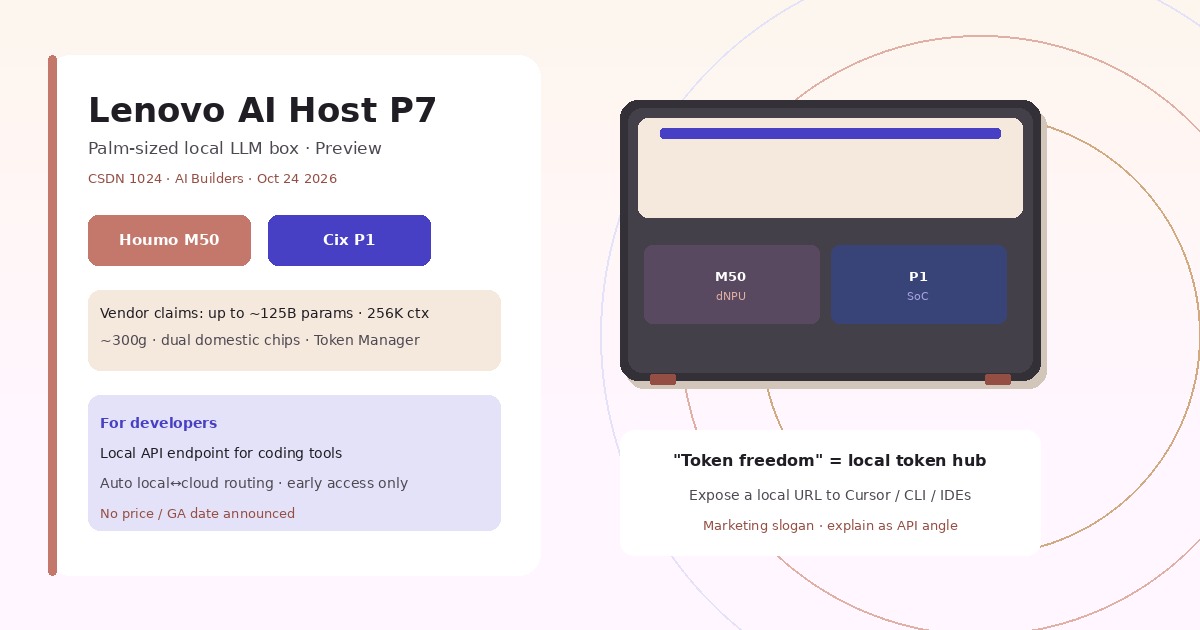
This is Lenovo’s productization angle on silicon we have already covered as chip stories (Houmo M50 open stack; Cixtech AGX Station). The P7 pitch is not “buy another NPU demo board.” It is a personal AI host that sits next to a laptop, runs sizable local models, and — via a Token Manager — exposes a local API/URL that coding tools can call. Lenovo’s marketing calls that “token freedom”; in plain terms it means fewer metered cloud tokens for everyday agent and IDE workflows, with an Auto mode that can still fall back to cloud when local capacity is not enough.
What was shown on Oct 24
Chinese coverage from IT之家 and 凤凰科技, plus an English-adjacent write-up on Offscreen Space, converges on a preview / early-access frame rather than a retail SKU:
- Form: palm-sized chassis, about 300 g. Earlier May materials (Houmo / Lenovo launch docs) cited max power around ~30 W and noise under 35 dB(A) — useful context, not restated as Oct 24 headline numbers.
- Dual chips: Houmo M50 compute-in-memory dNPU — press cites roughly ~160 TOPS at ~10 W; Cixtech / 此芯 P1 agent SoC — 6 nm, 12-core Armv9.2, about ~30 TOPS NPU / ~45 TOPS heterogeneous (vendor/press).
- Local models (Oct 24 preview wording): up to about ~125B parameters and 256K context.
- Bundled models claimed: Qwen3.8-Flash-Next, Qwen3.8-27B, Qwen3.6-35B-A3B, plus image / document / speech models; Lenovo Tianxi AI software; Auto mode routes local vs cloud.
- Architecture slogan: “天行 AI 计算架构”; INT4/INT8 mixed-precision claims averaging 98.3% of BF16 on four (unnamed) benches — treat as vendor marketing until independent benches land.
- Commercial status: preview + early-access “先享计划”; no public price or general-availability date.
May launch materials and an Oct 18 IT之家 reservation note cited roughly 122B params, 128K context, about ~50 tok/s, and ~190 TOPS combined. The Oct 24 preview wording moved to ~125B / 256K. Use the conference numbers as primary; keep the older figures as prior marketing, not as a silent upgrade claim you can verify from outside.
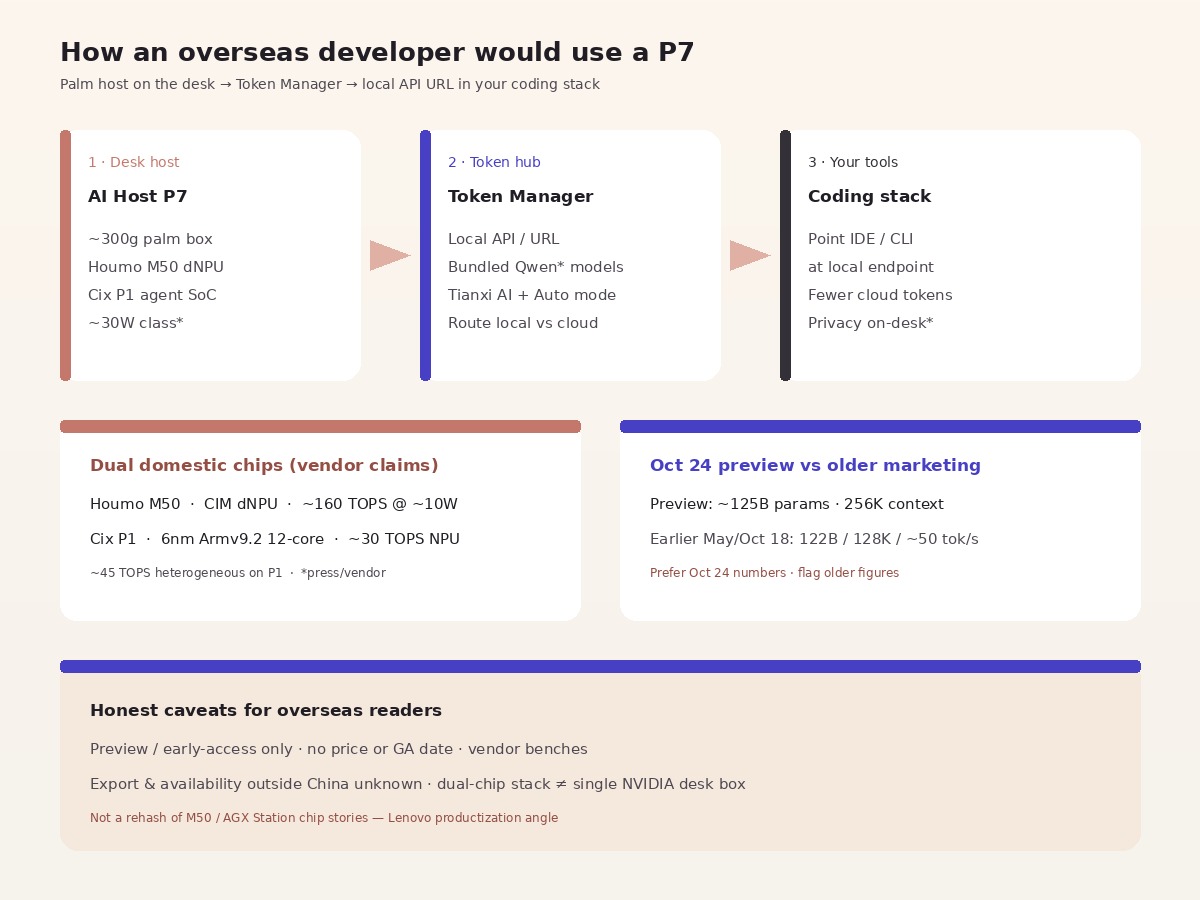
Illustration: desk host → Token Manager → IDE/CLI. Dual-chip TOPS and model sizes are vendor/press claims; export availability outside China is unknown.
Token Manager, without the slogan
“Token freedom” is Lenovo’s phrase. The concrete developer feature underneath is a Token Manager that surfaces a local API endpoint / URL so coding agents, CLIs, and IDEs can talk to models running on the P7 the way they already talk to OpenAI-compatible or similar HTTP backends. Auto mode can still spill work to cloud when the local stack is saturated or the task needs a larger remote model. That is the interesting comparison point versus: (1) pure cloud API boxes that meter every token, and (2) deskside NVIDIA-class machines (DGX Spark-class and peers) that are heavier, hotter, and usually a single-vendor CUDA stack.
P7 is aiming at a different seat: a quiet, palm-sized personal token hub for developers who want local defaults with a cloud escape hatch — not a rack-adjacent training box.
Not as a normal retail product yet. Early access is framed for the China launch path; export, distribution, and language/support for buyers outside China are not announced. Even if you can source a unit later, expect a dual-chip software stack (Houmo + Cix + Lenovo Tianxi) rather than a drop-in CUDA replacement — model conversion, driver maturity, and tool compatibility will decide whether the Token Manager story sticks. Treat Oct 24 as a product signal and early-access funnel, not a shipping SKU with a global store page.
How it sits next to cloud APIs and deskside NVIDIA
- Vs metered cloud APIs: if Token Manager works as advertised, daily coding/agent traffic can stay local until Auto mode escalates — useful for cost and for data that should not leave the desk. That is the honest reading of “token freedom,” not unlimited magic tokens.
- Vs DGX Spark-class deskside: P7 is smaller, lighter, and dual-domestic-NPU/SoC rather than a single NVIDIA stack. Peak FLOPS, software ecosystem depth, and multi-GPU scale are different categories; do not treat marketing TOPS as a head-to-head scoreboard.
- Vs prior Houmo / Cix coverage on this site: those posts were about the chips and developer boards. This post is about Lenovo wrapping them into a personal AI host with a coding-tool API surface.
Honest caveats
- Preview / early access only — no public price, no GA date.
- Vendor / press benches — ~160 TOPS @ ~10 W (M50), ~30/~45 TOPS (P1), ~125B / 256K, 98.3% of BF16, bundled Qwen* names — all company or trade-press claims until independent runs exist.
- Older marketing figures differ (122B / 128K / ~50 tok/s / ~190 TOPS combined). Prefer Oct 24 preview wording; do not merge the two silently.
- Export and availability outside China unknown.
- Dual-chip stack ≠ single NVIDIA deskside — different software path, different ecosystem maturity.
- Noise / power (~30 W, <35 dB(A)) come from earlier May materials, not restated as the Oct 24 headline.
Bottom line for overseas developers and hardware watchers: P7 is Lenovo’s attempt to turn two domestic AI chips into a pocket local-LLM host with a coding-tool API. Watch the early-access funnel for real Token Manager behavior, model quality at 125B-class INT4/8, and whether units ever leave China retail channels. Do not buy the slogan; wait for a price, a ship date, and third-party benches — and keep cloud APIs plus any CUDA deskside option on the same comparison sheet.