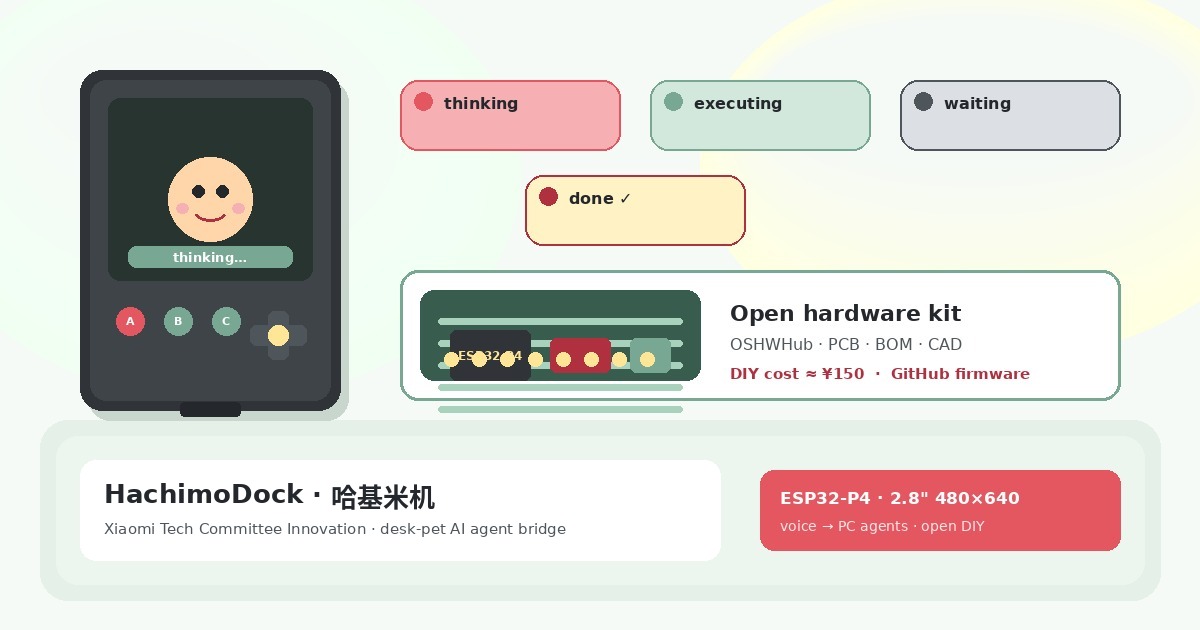
HachimoDock is not a Xiaomi store SKU. It is an incubated open hardware + software project: Pet Manager clients for Windows x64 and Apple-silicon macOS, ESP32-P4 firmware images in GitHub Releases, and a full PCB / BOM / CAD kit on OSHWHub. Chinese coverage on Oct 26 (IT之家, 新浪科技) puts DIY hardware cost around ¥150 (~$21). The same project was also mentioned around the WTCC 西岸科技消费嘉年华 (~Oct 22 per 澎湃), then got a louder spotlight at 观猹大会 2026 (Hangzhou, Oct 23–25).
What sits on the desk
The board is built around Espressif’s ESP32-P4 — RISC-V dual-core high-performance up to 400 MHz, with 32 MB Flash + 32 MB PSRAM in the documented kit. The face of the device is a portrait 2.8″ 480×640 MIPI-DSI panel. Inputs: three physical buttons plus a four-way stick with center press (the README maps that to 12 configurable gestures), plus an onboard mic. Daily link to the PC is USB-UART for flash, logs, and sync; the hardware still keeps USB HS OTG.
What makes it an agent accessory rather than another cute badge is the UI contract: the desk pet mirrors session states — thinking / executing / waiting / done — while voice can push tasks into PC-side agents the Pet Manager already knows how to talk to (examples called out in coverage and docs include Codex, WorkBuddy, Claude Code, and similar). Important auth confirmations still land on the PC client; the gadget is a presence + input surface, not a shadow admin console.
Public installers do not ship ASR/LLM API keys. You supply them. Docs mention Doubao as a common default ASR/LLM path; at least one release note also cites MiMo mimo-v2.6-flash as a default. Plan on Chinese cloud accounts (or whatever endpoints the client currently accepts) before you expect voice-to-agent to work out of the box.
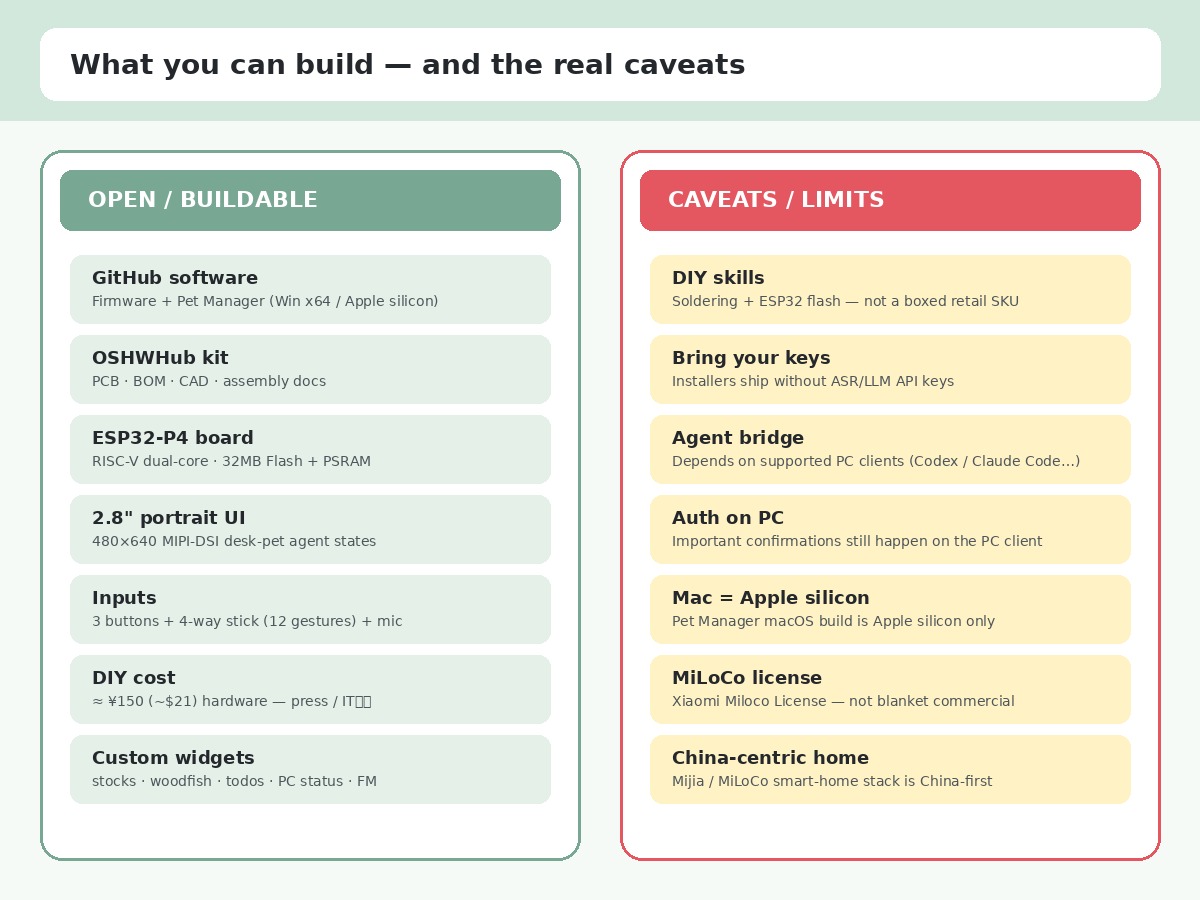
Open path vs caveats: GitHub + OSHWHub are real; soldering, API keys, agent-client support, MiLoCo license, and China-first smart home are the friction.
Can you build and use it outside China?
Partially yes — if you are comfortable as an ESP32 maker. Software and firmware are on a public GitHub repo (contributors listed on the README include Wanzheng Liu and Zinuo Tian). Hardware is documented on OSHWHub with PCB, BOM, and assembly material, so a non-China maker can order boards and parts globally in principle. The Pet Manager installs cover Windows x64 and Apple-silicon macOS only — Intel Macs are not in the public installers described today.
Where overseas use gets thinner:
- Agent bridge is client-dependent — voice/tasks only help if your PC agent stack is among the supported bridges. Treat “works with every coding agent” as marketing, not a guarantee.
- Smart home is China-centric — MiLoCo / Mijia integration is a real feature for Xiaomi-home users, but the stack and account assumptions are China-first. The Xiaomi Miloco License is not a blanket commercial free-for-all; read it before you ship a product on top.
- DIY, not retail — ~¥150 is hardware BOM talk from Chinese press, not a finished boxed product with support. Expect soldering, flashing, and debugging.
- Vibe-coding custom components — stocks, woodfish counters, todos, PC status, mini games, FM radio, and similar widgets are part of the pitch; they assume you will extend the open software, not that every widget ships polished.
What actually changes for agent UX
Most coding agents today live entirely inside a terminal or IDE chrome. HachimoDock’s bet is that a cheap, glanceable desk pet plus a mic can make long agent sessions ambient: you see thinking vs blocked vs done without alt-tabbing, and you can toss a spoken task at the PC agent while your hands stay on something else. That is a UX experiment more than a model breakthrough — and the open BOM is what makes it interesting for overseas makers who want to fork the form factor rather than wait for a Western desk toy with an NDA.
Honest caveats
- Incubated open project, not a Xiaomi Mall launch — Tech Committee Innovation Product Team incubated; press spotlight ≠ mass retail availability.
- DIY skill floor — ESP32-P4 flash + soldering + USB-UART workflow.
- No API keys in installers — you provision ASR/LLM yourself (Doubao / MiMo paths mentioned).
- Auth stays on the PC — sensitive confirms are not meant to be rubber-stamped from the desk pet alone.
- Mac = Apple silicon only in the public Pet Manager builds described today.
- MiLoCo license + Mijia stack — China-first smart home; not blanket commercial reuse.
- Cost is press/BOM — ¥150 figure from IT之家 / 新浪科技 Oct 26 coverage; your landed cost with shipping and tooling will differ.
Bottom line for overseas makers who already live in ESP32 + coding-agent land: HachimoDock is a rare Xiaomi-incubated open desk accessory that treats PC agent sessions as something you can see and talk to from the physical desk — with real GitHub firmware and an OSHWHub kit, at a DIY price that invites forks. Build it if you want the UX experiment; do not expect a plug-and-play Xiaomi appliance or a globally polished smart-home story on day one.